Mobile App Developer Twitter Header: Craft Your Digital First Impression
In the fast-paced world of social media, your Twitter profile is often the first handshake with a potential client, collaborator, or user. For a mobile app developer, this space is prime digital real estate. A generic, poorly sized image screams amateur hour. A Mobile App Developer Twitter Header is more than just a decorative banner; it's a strategic branding tool. It’s the visual elevator pitch that communicates professionalism, technical skill, and brand personality before a single tweet is read. This template isn't about slapping a logo on a gradient. It's a professionally crafted framework designed to help you build a header that works as hard as your code does.
Visual Anatomy: More Than Just Pixels
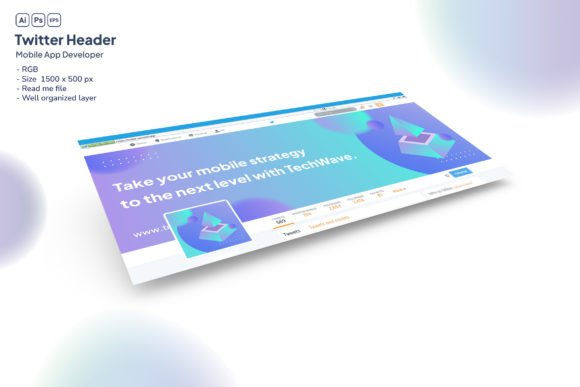
Let's dissect what makes a design like this effective. The visual characteristics of a strong Mobile App Developer Twitter Header lean towards modern typography and clean, functional layouts. You'll often see a bold, sans serif font used for headlines—think something with geometric clarity that mirrors the precision of UI design. This isn't the place for an ornate script font or a playful handwritten font. The personality here is one of clarity, innovation, and user-centric focus. The style is minimalist but not empty, using negative space intentionally to guide the viewer's eye. The appeal lies in its ability to project competence. A sleek layout suggests your apps are well-designed, intuitive, and cutting-edge.
The real power is in its customizability. This template provides the bones—a size 1500 x 500 px canvas in RGB color mode, optimized for digital display. You bring the soul. Swap in your brand's color palette to maintain consistency across your brand identity. Insert screenshots of your latest app interface, a compelling tagline about your development philosophy, or a clean icon representing your niche. The included files—Adobe Illustrator (.ai), Adobe Photoshop (.psd), and EPS format—give you the professional-grade control needed to manipulate every vector and layer. This is a design asset, not a finished product, which is precisely what makes it valuable.
Strategic Applications: Where This Header Works
While built for Twitter, the thinking behind a Mobile App Developer Twitter Header informs social media graphics across the board. The principles of clear hierarchy and brand alignment apply directly to your LinkedIn banner, your GitHub profile header, or the hero image for a portfolio website. It’s a component of your broader digital marketing toolkit. For a freelancer or small studio, this header acts as a silent salesperson, establishing credibility the moment someone lands on your profile to vet you.
The choice of sans serif font here is deliberate. In web design and app interfaces, sans serif typefaces are champions of on-screen readability, especially at smaller sizes. Using one in your header creates a seamless visual language that hints at the user experience within your apps. This consistency strengthens brand perception. When your Twitter profile, your app store screenshots, and your website all share a cohesive typographic style, it builds instant recognition. It tells a story of a developer who pays attention to detail—a trait clients and users deeply value.
Practical Guidance: Making the Template Your Own
So, you've downloaded the files. How do you proceed? Start by evaluating your project's fit. Is your brand voice more "friendly and accessible" or "enterprise and secure"? This will guide your customization. A fintech developer might use a deep navy and a stark, confident typeface. A indie game developer might opt for vibrant colors and a slightly more stylized, but still legible, display font.
Testing font pairings is crucial. The template likely includes a primary and secondary font. Don't just accept them. Experiment. Pair the bold sans serif with a complementary serif font for any supporting text if it suits your brand—this can add a touch of sophistication. The key is contrast and hierarchy. Your name or studio title should be the most prominent element, followed by a brief value proposition. Use the provided Read me file (.txt); it often contains licensing information and specific font names used, which is critical if you need to source them separately.
Remember, readability considerations extend beyond font choice. Ensure there's sufficient contrast between text and background. Avoid placing critical text over busy areas of a screenshot. Step back and view the header at the actual size it will appear on a Twitter profile—often quite small on a mobile feed. If it's legible at a glance, you've succeeded. This isn't just about making something pretty; it's about making it functional. A header that confuses is a missed opportunity.
Ultimately, this premium font template is a starting point. It provides the structure of professionalism, but the final output is your creative font choice, your imagery, and your message. It’s a tool for logo design thinking applied to a banner. Use it to craft a consistent, engaging, and trustworthy presence that turns profile visitors into followers, and followers into clients or users. In the crowded space of developers, a well-executed header is your first line of code in a compelling user story.